
Loaded and Leaning
A parked semi-trailer can look perfectly settled once the tractor pulls away. Underneath the front of that trailer, however, the landing gear is carrying a substantial part of the load. If one leg bends, collapses, sinks, or otherwise fails, the trailer can suddenly sit too low or lean heavily to one side.
That changes the problem from a routine pickup into Gilbert semi towing that may require lifting and stabilizing the trailer before another tractor can connect to it.
What Actually Happens When Landing Gear Fails?
Landing gear supports the front of a trailer whenever there is no tractor underneath it. With a loaded trailer, that means supporting not only the trailer itself but also a portion of the freight weight.
Failure does not always mean both legs collapse completely. One side can fail while the other remains standing, leaving the trailer tilted. A foot can sink into unstable ground. Damaged components can also leave the nose of the trailer sitting much closer to the pavement than normal.
The result is often the same: the trailer is no longer at a workable coupling height.
Why Can’t Another Tractor Just Back Under It?
A tractor’s fifth wheel needs to meet the trailer at an appropriate height so the kingpin can engage correctly. If the vehicle is leaning or its nose has dropped significantly, simply backing another tractor underneath may not be practical.
Trying to force the connection does not solve the failed support underneath the trailer, either. The trailer first needs to be stabilized and brought into a position where the next step can be handled properly.
This is where a landing gear problem becomes a recovery problem rather than just a mechanical one.
The Load Changes the Recovery
An empty trailer and a heavily loaded trailer can present very different lifting conditions. Freight adds weight, but its position matters too.
For semi towing in Gilbert, we need to consider what the landing gear was supporting before determining how to deal with the dropped trailer. Freight concentrated toward the front can place considerable weight near the area that needs to be raised.
Useful details include:
- Whether one or both landing legs failed
- How far the trailer dropped
- Whether it is leaning
- Whether the landing gear sank into the ground
- Whether the trailer is loaded
- Where the freight is positioned
- Whether the kingpin and trailer frame remain accessible
Those details help define what needs to happen before the trailer can move.
Getting the Trailer Back to Coupling Height
If the trailer is otherwise suitable to move, the objective may be to support and raise its front end enough for a tractor to connect.
During heavy-duty towing in Gilbert, lifting the trailer is only part of that process. The trailer also has to remain controlled while its weight transfers away from the failed landing gear. A significant lean or uneven footing adds another consideration because the trailer may not respond evenly as it rises.
Once the kingpin is back at a workable height, a tractor may be able to get underneath and support the front of the trailer again.
What If the Trailer Cannot Be Reconnected?
Not every landing gear failure ends with another tractor simply driving the trailer away.
Damage may extend beyond the landing gear itself, or the trailer may not be in a condition to continue normally. In those situations, tractor-trailer recovery around Gilbert has to account for the condition of the trailer as well as the failed legs.
The goal is not merely to make the trailer stand up again. It is to determine what can happen with it afterward.
Sometimes the Ground Causes the Failure
Landing gear does not have to break mechanically to create this problem. A loaded trailer parked on soft or unstable ground can push a landing foot downward until the trailer begins to lean.
That distinction matters during semi recovery near Gilbert. A damaged landing gear assembly and a trailer sinking into the ground may look similar from a distance, but they can require different approaches to support and reposition the load.
Valley Express Towing for Gilbert Semi Towing
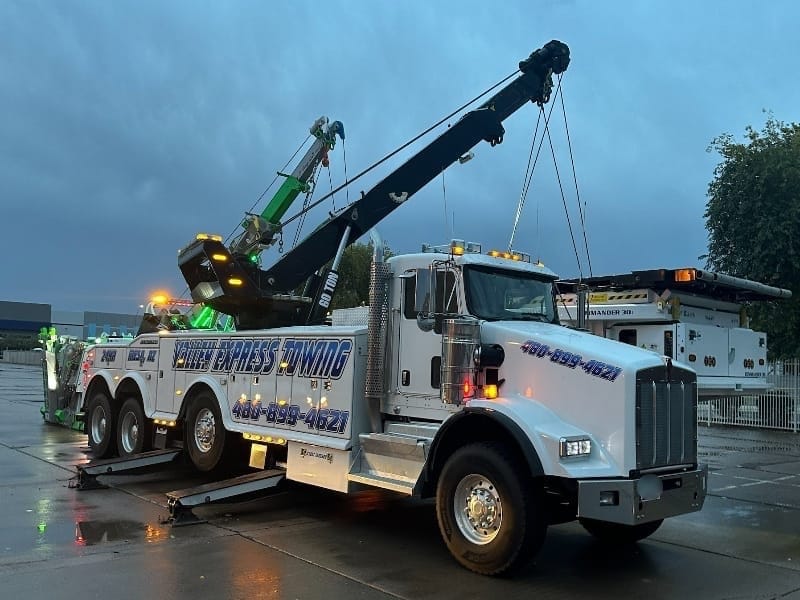
Valley Express Towing has served Mesa, Phoenix, and surrounding Arizona communities since 1994. Our 22-truck fleet includes four heavy-duty wreckers, including a 60-ton rotator, along with 50-ton, 35-ton, and 25-ton wreckers.
That range gives us options when Gilbert heavy-duty towing involves more than pulling a disabled truck down the highway. A dropped loaded trailer can require support, lifting, and careful repositioning before it is ready to move.
With Gilbert semi towing, landing gear failure is a good example of why the first problem sometimes has to be solved before the actual tow can begin.
FAQs
What happens when trailer landing gear fails?
The front of the trailer can drop or lean because it no longer has proper support. With a loaded trailer, the weight of the freight can make the situation more complicated.
Can a tractor connect to a trailer with collapsed landing gear?
Not always. If the trailer has dropped below normal coupling height or is leaning, the fifth wheel may not be able to engage the kingpin correctly.
Can only one landing leg fail?
Yes. One leg can bend, collapse, or sink while the other remains standing. This can leave the trailer leaning heavily to one side.
Can soft ground cause a trailer to drop?
Yes. A landing foot can sink into soft or unstable ground under the weight of a loaded trailer, even if the landing gear itself has not mechanically failed.
Does the cargo affect how a dropped trailer is recovered?
It can. The amount and position of the freight affect the weight being supported near the front of the trailer, so the load needs to be considered before lifting begins.
Can a trailer be used again after a landing gear failure?
That depends on what was damaged. Raising the trailer back to coupling height does not automatically mean it is ready for the road, so the trailer’s condition still needs to be evaluated.